Content Warning: death, grief, addiction.
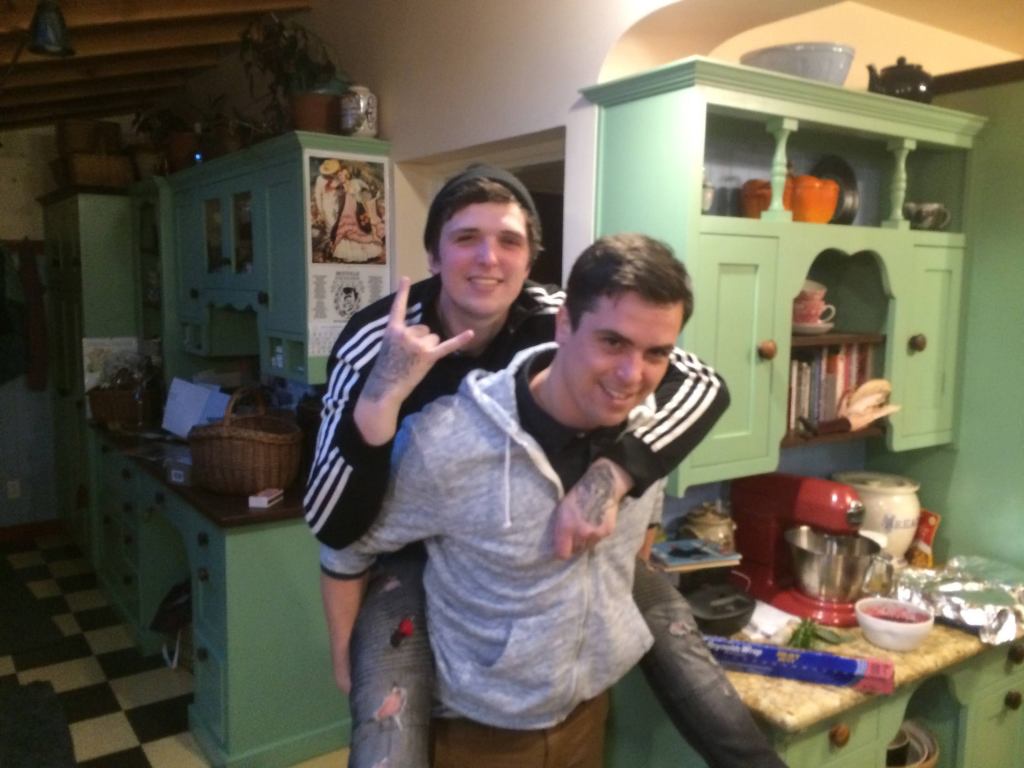
One year ago today, without knowing it, I was about to see my little brother for the last time. He wouldn’t stay long, he was just dropping by to pick up something from his stash of belongings in my basement, I don’t even remember what now.
What I do remember was his momentum. This wasn’t a drop by to kill time situation, or a hang around because something was going badly and he didn’t know how to even bring it up kind of scenario. He had places to go, and things to do: we talked about his plan to go to a new meeting that evening, about finding a regular pickup basketball game to join, about the 7 am on Saturday meeting he was about to start chairing just down the street from where I live. He was in motion, filling his life back up, and he was sorry he couldn’t hang out longer. He hugged me, and told me that he loved me and that we’d talk soon, and then he was gone.
The next morning, when I got the call I’d been half expecting for nearly a decade, I couldn’t believe it. In the moment all I felt was confusion. I’d prepared for this day and this call before, more times than I want to ever think about, but my brain refused to register it. He can’t be dead, a voice screamed inside me. He was right here. Just now. He can’t be gone.
I never did see him again, until several days later when I drove to an old funeral home and picked up the surprisingly heavy box containing his ashes. But the morning I got that call I did have to go to the group halfway house where he’d been living, and pick up his few remaining belongings. His Big Book. The watch I’d given him when he entered recovery the time before last, which he’d never sold. His still-damp towel.
The kid who met us at the house showed me where he’d found my brother, on a couch in the sparse main living area, just feet from where they kept the Narcan. His face had been blue when he found him, the kid said, and the fear and sorrow in his face was almost worse than seeing my brother’s dead body itself.
It took months before we actually knew what had happened. Amidst an opioid epidemic that was taxing resources locally as well as nationally, the cue for toxicology reports was depressingly long. Plenty of time, it turned out, to research all the myriad ways in which the modern synthetic opioid market can kill you. The “benzo dope” that knocks you out longer than the fentanyl lasts, so you wake up in polydrug withdrawal. The “tranq dope” that uses the veterinary sedative xylazine to similar effect, and which creates grotesque necrotic lesions in intravenous users. The carnival of horrors that has emerged from our endless, frantic search for something that will stop all the pain.
As it turned out, none of that was necessary. My brother had been sober for nearly six months at the time of his death, one of his longer stretches over the preceding decade, and he’d simply accidentally overdosed on fentanyl. It’s possible that one of the blue pressed pills found on him had been mis-dosed, fentanyl is notoriously hard to measure and dose accurately due to its extreme potency, but then again maybe not. Maybe he just took one or two, and the low tolerance he’d earned during recovery took care of the rest. The only thing that mattered to me is that he didn’t try to take everything he had. He wasn’t trying to escape, he just slipped up once.
My brother was ten years younger than me, but when he died he had more grey hair than I even do now, one extremely difficult year later. This was pointed out to me by his rehab roommate, when I came to visit on the Easter before he passed, to share a cafeteria meal, some chitchat and a meeting. “Well, he definitely earned them,” I said, and we all laughed. “I might even be responsible for a few of his,” my brother added with a chuckle that hid a look in his eyes that made it clear he wasn’t joking at all.
When someone is gone you get a lot of clarity about the ways that they actually affected you and your life, and my brother’s admission that he’d put me through a lot wasn’t exactly controversial. There are chapters of my book “Ludicrous” that are still hard to read because I’d been working on them during one of the worse moments of his long addiction. I remember spending the better part of a day just frozen in front of the computer, staring at the draft, paralyzed. There are even vacations that have faded into a vague haze, crowded out by the intense pain and helplessness brought on by a phone call update.
The thing that has got me through the last year, the reason that I’m able to write about this topic at all at this point, is that I was lucky enough to have other memories with him as well. During the last months of his life, when he was in rehab for the final time, I spent every Sunday afternoon with him during visiting hours, and was able to see a side of my brother that I’d only rarely seen before. Like his joke about grey hair, he was introspective, thoughtful and intensely keyed into his impact on others. It was like he was a different person than the one I’d interacted with for so long, except that this was actually, at long last, the real him.
When someone you love has been hollowed out by their addiction, to the point where you don’t even know what’s left of the person you think you remember, there is nothing more beautiful than getting them back. I can’t even say exactly how long I got my brother back, but it was probably measured in hours. What I learned from the experience is that it doesn’t even matter how long it was. It could have been 30 minutes or 30 years. What matters is that I got that glowing, golden moment when he was really there, and he was really trying to reconnect with himself, and with me, and with the very idea of a life that was worth living.
However much time it was we spent in the dining room or back patio of is rehab facility, or after that during his few brief visits to my home from his halfway house not far away, it was enough. It forms a bright, golden, shining moment in my memory, that eclipses the ocean of pain, and confusion and turmoil that lies beyond it. I know that he believed that there was nothing he could do to make up for all the grey hairs he had given me, but at the end it turned out that he was wrong about that. He could, and through his own strength and the support of his recovery community, he gave me the gift of himself at a time when neither of us were even sure he was still his to give.
I only wish he still could.


 E.W. Niedermeyer
Leave a reply to Jay Cancel reply