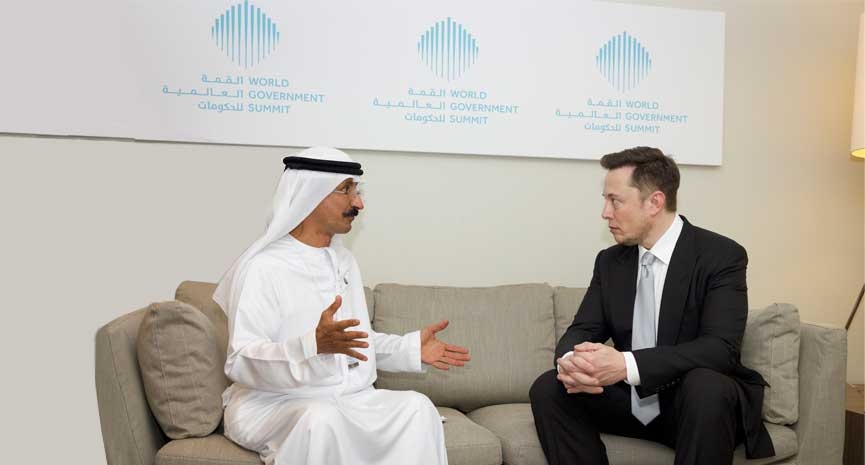
“Dear Jeffrey Sorry we kept missing each other,” Sultan Bin Sulayem wrote [PDF] his old friend on September 15, 2014, “I was distracted by the Ukrainians!!”
But the CEO of Dubai Port World wasn’t just writing Jeffrey Epstein about his exploits with the citizens of country another correspondent called [PDF] “The land of plenty” (to which Epstein replied “Nasty ukrainians ;)”. This time a different kind of desire motivated Bin Sulayem to email his crony: the need for a hot ride.
“By the way do you happen to know the people who make the Tesla electric car?” he wrote Epstein. I would like to order 3 of Tesla X model but the order Queue is so long.” He included a link to the Model X product page on the Tesla website before signing off “Yours, Sultan.”
He had hardly needed to ask. Of course Epstein knew “the people who make the Tesla car.” Not even two weeks earlier Epstein had emailed [PDF] Elon Musk, writing “spoke to [fellow PayPal founder] reid hoffman yesterday, are you planning to do st barth again for xmas?” When Musk tersely replied “Don’t know,” Epstein once again invited him to Little St James: “you are welcome to the island . reid is coming with joi ito, on the 6th of dec come vist.”
If Musk responded directly to this offer it is not preserved in the Files. Prior to Bin Sulayem’s request, Epstein’s interest in Musk’s business seems to have been far more focused on SpaceX and the satellite communications sector more broadly than Tesla. Bloomberg reports that Epstein had started advising OneWeb founder Greg Wyler in 2012, and appears to have been trying to facilitate a collaboration between the two entrepreneurs, as well as an investment for himself.
It’s not clear whether Epstein’s visit to SpaceX was related to this interest, some other business, or strictly pleasure, but the record indicates his interest in Tesla was limited. Though he (unsuccessfully) tried to rent a Tesla for his SpaceX visit in early 2013, the only reference [PDF] to Tesla’s business up to this point was a FT story about the EV maker hitting a “critical production milestone,” that someone sent Epstein with the comment “Doesn’t look that great :(“. Epstein did receive an allocation [PDF] in the IPO of Tesla’s Autopilot technology partner Mobileye over the summer of 2014, however, suggesting a characteristically shrewd optimism for the narrative that would send Tesla’s valuation stratospheric (albeit without Mobileye’s short-lived partnership).
About two weeks after his first request for a connection with “the people who make the Tesla car,” and having apparently received no reply, Bin Sulayem wrote Epstein again [PDF] about the EV. “Can you check how I can purchase and get delivery of 3 Tesla model X for me my son and my wife,” he wrote. “I understand the delivery will be in early 2015. I am ready to pay for them fully in advance.” “Waiting for ansser,” Epstein replied [PDF] later the same day. Five more days passed before Bin Sulayem once again requested an update [PDF] on October 4, to which Epstein enigmatically replied “no answer until nov 15.”
The most likely explanation for Epstein’s answer is that he meant to write “nov 5,” which is when Tesla reported its third quarter earnings, and (as it would turn out) disclosed that deliveries of the Model X had been delayed again, to the third quarter of 2015. But even by then the news was effectively weeks old, as Morgan Stanley’s notoriously Musk-friendly analyst Adam Jonas had pre-dropped the news on October 16. The only obvious explanation for Epstein’s expectation to receive inside information about Model X availability on November 15, 2014 is that he thought someone might give it to him at his New Mexico “Zorro” ranch, where he was scheduled [PDF] to be on that date.
In any case, the record goes dry at this juncture, with regard to Bin Sulayem’s request for a family pack of Tesla Model Xs. The whole episode strikes an odd tone: the Dubai port magnate apparently intuiting that Epstein had a connection with Musk, and haranguing him for an answer as if the financier were a slow-moving concierge. But the record shows this wasn’t out of character for their relationship, with both men engaged in an intensive, ongoing exchange of favors, large and small. Bin Sulayem was comfortable asking for Epstein’s help obtaining Teslas, or New York real estate, or DNA testing kits, and in exchange Bin Sulayem let Epstein use a shell company under his name to purchase Greater St James from an owner who refused to sell to him [PDF]… and oh [PDF] you know [PDF] other stuff [PDF].
Indeed, the record suggests a much deeper relationship of mutual benefit between the two men, predating Epstein’s 2008 conviction, and intensifying after. Bloomberg reports the two men were introduced by New York real estate investor Andrew Farkas, and Epstein attempted to broker deals between Bin Sulayem and a number of his best-known contacts, including Tom Pritzker of Hyatt hotels, Les Wexner of L Brands, Jes Staley of JP Morgan Chase (later of Deutsche Bank), and former Israeli Prime Minister Ehud Barak. It’s possible that the relationship was most deeply forged in 2009, when Epstein appears [PDF] to be helping [PDF] Bin Sulayem message a UAE bailout of his heavily indebted Dubai World port firm… whose every word [PDF] (not to mention company [PDF]) the New York Times’ man in Dubai, Landon Thomas Jr, positively [PDF] hung on [PDF].
Dubai World’s debt woes were back in the news in 2015, when Bin Sulayem once again asked his longtime crony for a Tesla-related hookup. This time he was asking for the kind of business connection that had earned Epstein a sharp rebuke from Musk when he had broached it on behalf of Ehud Barak (as we saw in Part One): a partnership to bring Tesla to Dubai, a small market it wasn’t yet operating in. At the end of an exchange about meeting at Epstein’s ranch [PDF] on July 24, Bin Sulayem wrote “By the way is they any one you know who can arrange a meeting for me with Elon Musk. I want to convince him to open his show room For Tesla in DUBAI. Also I want use His solar system modular batteries to power my New hotel Dukes Dubai opening this December.”
Epstein swiftly forwarded Bin Sulayem’s request [PDF] to a redacted confidant with the subject line “Re: from sultan, are you still in contact with kimball,” to which the recipient replied “Yeah, I’ll see Kimbal next weekend. Should I forward this to him?” It’s not entirely clear whether this approach yielded the eventual results, in fact it seems likely not to have, but the email suggests that Epstein continued to see Elon Musk’s brother as the easiest path to the more prickly Tesla mogul. Just that June Epstein told a correspondent that “I gave another girl to kimball and he is thrilled,” while an enigmatic email [PDF] from January of the same year also seems to show a mutual friend (or Musk family member?) references Kimbal recovering from a broken neck when asking how Sultan was doing following an apparent spinal injury in Germany [PDF].
Ironically enough, Epstein’s path to pitching Elon on behalf of his Emirati pal ran through Reid Hoffman, whose Greylock colleague arranged [PDF] a star-studded dinner on August 2 where the two men would meet again. Musk has since chosen Hoffman as a kayfabe nemesis, but he answered his former PayPal colleague’s invitation, along with Mark Zuckerberg and his wife Priscilla Chan, Peter Thiel, and of course Jeffrey Epstein (among others). The day of the dinner Epstein wrote Bin Sulayem asking for a more detailed pitch, to which
Dear Jeffrey
Well his car is so popular in the Middle East and the problem is if he wants to sell his car directly in the middle east the rule for doing business is that he would need to appoint an agent or a partner.
This is something I do not recommend as he might end up with the wrong agent and it’s difficult to change again.
So my recommendation is that he opens his Middle East show room and service center without a partner or agent and that can only be achieved at Jebel Ali free zone business park which is the most successful free zone in the world. This would give him full autonomy to establish his business and supply the whole Middle East market with ease.
I established the Jebel Ali Free Zone 30 Years ago and I continue as the chairman of the free zone. We have over 7000 companies doing business with a total turnover of $150 B per Year.
This is a free zone therefore there is no income tax. The customer who buys the Tesla car will pay the custom duty which is 5% of the sale price of the car.
I also hold the position of Chairman of the Customs and Ports as well and can send you a separate email of my full profile.
I don’t expect anything for myself or any one else in Dubai and you know me very well.
I am willing to arrange that he opens his showroom For Tesla on Shaikh Zayed road which is the most prominent street in DUBAI.
I can arrange for him to own his business 100% without a need of a local partner and to help him start his business DPW will buy a large number of Tesla (Maybe 50 cars) and I will subsidise it for our own employees.
If he does not want to invest in building a showroom we are willing to custom build his showroom and service center as per his design and we will lease it to him.
I believe Jebel Ali is the right location as people can buy the car ship it to all middle east countries and provide service from Dubai
I truly believe he will be very successful. In fact already people are buying Tesla directly from Europe including myself, my wife and my son. At least 30 others are already on the streets of Dubai and our electricity company has installed 100 charging points throughout Dubai already with more to be installed in the coming months.
It seems Bin Sulayem’s interest in renewable energy went back some time, and was in fact encouraged by Epstein. In 2011 the Emirati had forwarded a newsletter [PDF] hyping batteries as enabling new technological possibilities to Epstein, with the plaintive message “is this true”. Epstein’s answer displays his unique blend of total cluelessness about anything substantive but shrewd social instincts: “but the battery does not last this might be possible inn 20 years . but by that time bio batteries shouuld be up and running,” he wrote, bafflingly. “ALternaitve energy could be another Dubai centered bus[iness], Not only are you politcallu stable, but plenty of sun. nuclear enery will now take a back seat. due to japan.”
We can’t say for sure whether Epstein made Bin Sulayem’s pitch at that 2015 dinner, as it seems he didn’t respond to the latter’s request [PDF] for an after-action report, but the two men appear [PDF] to have spent time at the ranch later in August. A quiet period in the record, at least with regard to direct references to Tesla and Musk then ensues until 2017, when everything the Emirati magnate promised in his pitch suddenly materialized… and more.
Beyond the Epstein Files, you can see the wheels starting to turn: in April of 2016, the Dubai Future Foundation launched an autonomous transport strategy aimed at automating 25% of miles traveled by 2030, with a video showing a driverless Tesla taxi. In August the Dubai government committed to making 10% of its fleet vehicle purchases electric or hybrid. Later that year Dubai’s Road and Transport Authority (RTA) signed a deal with the Musk-inspired Hyperloop One project to “explore” a Dubai-Abu Dhabi route, with Bin Sulayem’s DP World later funding half the company’s Series C investment round (he would go on to become the ill-fated company’s chairman in 2018, and DP World would ultimately end up with its IP when it went under in 2023).
Then, in early 2017 it all happened: Musk launched a new Dubai operation, complete with no local partner and Sheikh Zayed Road dealership, just as Bin Sulayem had offered. If we take the Emirati at his word, there was no way to achieve this except through the man that Jeffery Epstein appears to have pitched to him.
With Bin Sulayem’s blessing, all of Dubai rolled out the red carpet for Tesla. In addition to inviting Musk to the World Government Summit, the emirate’s transport authority agreed to buy 200 Teslas “fitted with autonomous driving technology” to serve as taxis and limousines. Dubai’s Department of Economic Development pledged to assist Tesla in expanding throughout the region. By the end of the year, Tesla delivered 50 Model S for what Dubai Future Foundation-funded outlets like Futurism described as an “autonomous taxi service,” and Bin Sulayem’s DP World was “mulling” further collaboration with Tesla.
The reason Epstein’s Dubai pitch worked better than his Israel pitch had was simple: timing. In summer of 2013 Tesla was struggling to expand its sales and service footprint to meet what was by then accelerating demand; by 2015 Tesla had expanded to most major markets, the Model S was aging, its new Model X was expensive and quirky, and it would be years before the Model 3 carried the company into its next chapter. By the time Tesla moved into Dubai in 2017 it was headed for another of its regular financial crises, thanks to Model 3 “production hell,” and desperate for the incremental sales of its high-priced cars.
Though Musk and Epstein would find themselves pulled by cross-currents in the rich but murky waters of the Middle East, the relationship that Epstein appears to have brokered with Bin Sulayem has made Dubai Tesla’s foundation in the region ever since. Musk last met with Dubai’s ruler in December, his favored propagandist lives there, Dubai is one of the few customers for his absurd Boring Company (despite their loss on Hyperloop One), it’s reportedly a dumping ground for the slow-selling Cybertruck, and Tesla is even readying a local version of FSD (Supervised) that Musk says will be ready for release soon.
It’s impossible to prove that all this was definitely the result of Epstein’s pitch, but the circumstantial evidence is considerable. More importantly, the entire relationship dynamic that Musk and Dubai have cultivated reflects the kinds of relationships Epstein seems to have specialized in: a mutual aggrandizement and indulgence in the gauzy shared fantasy of an increasingly out-of-touch elite. The infamous credulity and fanatical loyalty evinced by Tesla’s shareholder base, long explained in the financial media as a retail cult, makes far more sense with the vast wealth of Epstein-manipulated Gulf princelings behind it.
Indeed, Epstein seems to have been deeply involved in selling the Silicon Valley mystique to the deep reservoirs of petro-wealth across the Middle East. As we will explore in Part Three, Epstein was as connected with the Saudis as he was with Sultan Bin Sulayem and Dubai, and he appears to have built on the Tesla-Dubai model by increasingly brokering convergences of oil money and cash-hungry technology companies. A wave of Gulf State capital was headed towards Silicon Valley that would fuel some of the most dramatic and troubling changes in its culture, and birth our modern world, and it should come as no surprise that Jeffrey Epstein and Elon Musk were at its forefront.
 E.W. Niedermeyer
Leave a comment